Smart Prompts, Smarter Work: The Guide to Prompt Engineering for Beginners
Shifting from ad-hoc queries to engineered prompts cuts operational chaos and safely scales workflows.

Yet, when you actually sit down in front of a generative AI tool like ChatGPT, Claude, or Copilot, the results can feel underwhelming. You ask for a market analysis report, and it hands you generic, surface-level fluff. You ask it to draft an internal controls policy, and it misses critical regulatory nuances entirely.
The issue isn’t the AI. The issue is communication.
Think of generative AI models like an incredibly brilliant, newly hired intern. They possess access to vast repositories of human knowledge, but they lack context, boundaries, and your specific business acumen. To extract genuine value from them, you have to give them precise, unambiguous instructions.
This skill is known as prompt engineering. For small-to-medium business owners and information security specialists, mastering prompt engineering for businesses is no longer an optional tech gimmick—it is the ultimate modern leverage point to reduce chaos, secure workflows, and scale smarter.
Why General Prompts Fail in Business Operations
Most business owners interact with AI via “ad-hoc querying”—typing simple, unstructured statements. For example, a founder might type:“Write a vendor onboarding email for our company.”
While the AI will generate a grammatically correct response, it doesn’t know your business. It doesn’t understand your vendor screening requirements, your payment terms, or your required internal controls. The output requires significant editing, which defeats the purpose of automation.
In contrast, structured prompt engineering treats the AI as a programmable engine. By feeding it systematic inputs, you gain highly repeatable, highly customized, and production-ready outputs. Harvard Business School researchers found that professionals utilizing structured prompt workflows execute knowledge-intensive tasks up to 25% faster while achieving significantly higher quality results.
The “CARE” Prompt Engineering Framework for Beginners
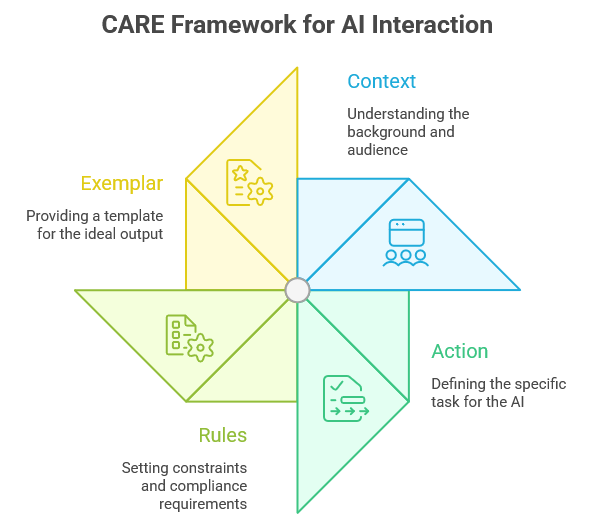
To avoid generic responses, stop writing commands and start building systems. As a systems consultant and auditor, I recommend using a structured framework. One of the easiest to apply to daily business operations is the C-A-R-E Framework:
Putting CARE to Work: A Real-World Comparison
Let’s look at how an Information Security Specialist or IS Auditor might use this to draft a high-level incident response policy snippet.Instead of typing “Write an incident response process for data breaches,” you construct a precise prompt using CARE:
Context: You are a Senior IS Auditor and cyber compliance consultant advising an SMB fintech provider that processes regional digital transactions.
Action: Draft a high-level, 4-step sequence for internal incident triage when a suspected data anomaly or breach occurs.
Rules: Keep the language professional and technical yet clear enough for internal IT staff. Ensure it emphasizes isolation of affected environments before public reporting. Do not include vague placeholders.
Exemplar Format: > Step 1: [Action Name] – [Brief Executive Objective]
Primary Responsibility: [Role]
Verification Mechanism: [Control]
By implementing this structure, you save hours of back-and-forth revisions. The AI immediately understands the risk profile, the specific regulatory context, and the exact syntax you expect.
3 Strategic Areas Where Prompt Engineering Drives Business ROI
1. Financial Documentation & Reporting Clean-Up
Managing messy general ledgers or parsing lengthy contract clauses creates operational friction. By prompting AI with data-parsing parameters, you can extract structured insights rapidly. For example, you can paste unformatted billing text and instruct the AI to extract specific metadata, line items, and tax identifiers directly into clean CSV structures, completely bypassing manual data entry.
2. Workflow Automation and Code Generation
You don’t need a computer science degree to automate repetitive office tasks. Prompt engineering allows founders to generate Google Apps Scripts, Excel macros, or Zapier webhooks. You can explicitly instruct an AI model to write a script that monitors a specific shared folder, extracts data from incoming PDF invoices, and logs it into a tracking sheet—building internal control mechanisms without hiring expensive external development teams.
3. Compliance and Internal Controls Mapping
For IS auditors and compliance enthusiasts, tracking regulatory framework updates can be exhausting. You can leverage structured prompts to cross-reference your current internal policies against updated standards (like ISO 27001 or local privacy laws). The AI can perform a preliminary gap analysis, highlighting exact clauses where your existing controls require updating.
The Security and Governance Warning: Protecting Your Business Data
As a business systems and information security consultant, I must emphasize a critical caveat: Never feed sensitive corporate records, client identities, protected intellectual property, or raw financial ledgers into public generative AI models.Most public, free versions of AI tools utilize user inputs to train future models. If you paste a proprietary client contract or unannounced financial metrics, that data could theoretically be exposed to third parties.
To implement prompt engineering safely within your business operations, follow these data hygiene rules:
Anonymize Data First: Replace real client names, exact dollar figures, and unique proprietary identifiers with generic handles (e.g., change “Client Acme Corp” to “Client X”).
Use Enterprise-Grade Deployments: Utilize platforms that explicitly offer enterprise data privacy compliance guarantees (such as APIs, custom private deployments, or setups where data training is turned off completely).
Establish an Internal AI Policy: Standardize what your team can and cannot paste into AI platforms. Efficiency should never come at the expense of sound internal governance.
Turn Prompts Into Scale
Prompt engineering for businesses is not about learning a coding language; it is about defining exact business requirements. When you shift your perspective from treating AI as a casual conversation partner to treating it as a highly configurable, rule-driven system, your operational efficiency skyrockets. You reduce business chaos, create airtight internal workflows, and free up valuable time to focus on strategic, revenue-generating growth.
FAQs
Q: Do my team members need technical coding skills to utilize prompt frameworks?
A: No. Prompt engineering relies entirely on natural, structured human language. The core requirements are logic, deep familiarity with your business rules, and clear written communication.
Q: How do I know if an AI-generated output is compliant with standard audit procedures?
A: AI should only handle the initial heavy lifting or structural draft. Every single automated output must be subjected to human review and verification by an expert or designated internal owner before deployment.