
ICFR and Why It Matters To Even Private Companies
TL;DR
Internal Control over Financial Reporting (ICFR) is a structured process to ensure the accuracy and reliability of a company’s financial statements. While often associated with large public corporations due to regulations like SOX, ICFR is equally vital for private companies in India. Implementing robust ICFR safeguards assets, mitigates financial risks, enhances decision-making, and builds crucial stakeholder confidence, paving the way for sustainable growth and compliance.As the CFO or owner of a private company in India, you are constantly balancing growth ambitions with operational efficiencies, compliance requirements, and risk management. In this intricate dance, the integrity of your financial data forms the very foundation of every strategic move. While terms like “Internal Control over Financial Reporting” (ICFR) often evoke images of large, listed entities grappling with Sarbanes-Oxley (SOX) compliance, the underlying principles and immense benefits of ICFR are equally, if not more, critical for private businesses.
Often, private companies perceive ICFR as an additional, costly burden. However, a well-implemented ICFR framework is not merely a compliance checkbox; it is a strategic asset that strengthens your financial backbone, safeguards your resources, and elevates your entire operational landscape.
Let’s demystify ICFR and explore why it is indispensable for non-listed entities.
What Exactly is Internal Control Over Financial Reporting (ICFR)?
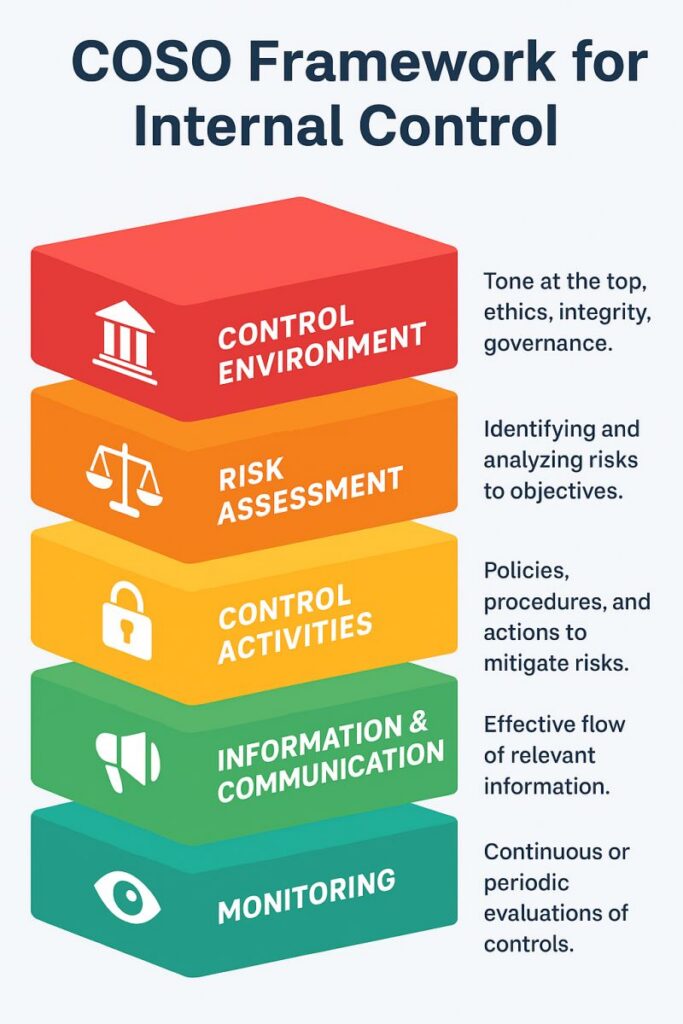
At its core, ICFR is a comprehensive system of policies, procedures, and practices designed and maintained by a company’s management and personnel to provide reasonable assurance regarding the reliability of financial reporting and the preparation of financial statements in accordance with Generally Accepted Accounting Principles (GAAP).It encompasses more than just financial figures; it touches every process that culminates in your financial statements. Think of it as a quality assurance system for your financial data. The Committee of Sponsoring Organizations of the Treadway Commission (COSO) framework, widely recognized globally, breaks down internal control into five interdependent components:
Why ICFR Matters to Private Companies: Beyond Regulatory Mandates
While private companies are not subject to the extensive public company mandates like SOX Section 404, the principles of ICFR offer profound benefits that directly impact their financial health and long-term viability:Compliance and Regulatory Landscape for Indian Private Companies
Even without a direct equivalent to SOX for all private companies, the spirit of internal controls is embedded in various Indian regulations:
Companies Act, 2013: While the auditor’s reporting on the adequacy of internal financial controls (IFC) and their operating effectiveness under Section 143(3)(i) primarily applies to listed companies and certain other companies, the underlying expectation of robust controls applies to all. Similarly, the Director’s Responsibility Statement under Section 134(5)(e) implicitly requires directors to ensure adequate internal controls.
Goods and Services Tax (GST): Accurate financial records are paramount for GST compliance. Strong ICFR ensures proper classification of goods/services, correct input tax credit claims, timely generation of e-invoices/e-way bills, and accurate filing of GSTR-1, GSTR-3B, and GSTR-9. Weak controls can lead to incorrect tax payments, penalties, and disputes with tax authorities.
Income Tax Act, 2025: Reliable financial data is fundamental for accurate income tax computation, timely Tax Deducted at Source (TDS) and Tax Collected at Source (TCS) compliance, and preparing precise annual returns. Good ICFR minimises the risk of errors that could lead to tax assessments, interest, and penalties.
Auditor Expectations (SA 315): Even where formal ICFR audits aren’t mandatory, your statutory auditors are required by auditing standards (like SA 315, Identifying and Assessing the Risks of Material Misstatement Through Understanding the Entity and Its Environment) to understand and evaluate your internal controls as part of their audit procedures. Weak controls increase the inherent risk of material misstatement, often leading to more extensive (and potentially more expensive) audit procedures.